
Beyond the Compliance Checkbox: Ethics & Integrity at the Heart of the Stewardverse Leadership Institute.
What does it actually mean to lead with integrity — and why are so many well-intentioned leaders still getting it wrong?
There is a persistent myth in training and development: that ethics can be taught by learning the rules. Attend a seminar, sign a code of conduct, complete the annual compliance module. Box checked. Values instilled.
As we build the Stewardverse Leadership Institute in the coming months, our goal, in part, is to dismantle that myth.
Three strong beliefs around Ethics & Integrity underpin our work in these early stages of development:
From Perception of Burden to Business Value: Ethics and Integrity can evolve from a compliance burden into a strategic core value that permeates entire organizations and supply chains.
Business Success Is Generational: Business rewards can align with doing the right thing for people, the environment, and future generations.
“Preactive” Decision-Making Matters: The real work of Ethics & Integrity can happen on the front end of business planning by asking: What will my values tolerate, and what will they not?
The Diagnosis: Why Good Leaders Make The “Easy” Choice.
The Institute begins with an honest reckoning. The global business community is not suffering from a shortage of ethics policies. It is suffering from a fracture between stated values and actual decision-making.
The reasons can be structural. Short-term financial incentives pull in one direction. Fiduciary frameworks, narrowly interpreted, pull in another. Peer pressure, competitive anxiety, and the sheer velocity of modern business make it easy — even rational-seeming — to sideline integrity in the name of expediency. When others go down the road of being less ethical, the consequences are felt far and wide.
The result, as the Institute's founding framework puts it plainly: "brute-force leadership, without consideration for people and nature, is corrupting and degrading the quality of leadership across business, government, and core institutions."
This isn't a moral failure unique to bad actors. It is a systemic failure that ensnares leaders every day. The Institute aims to treat it as such.
The ongoing scrutiny of different DEI positions at retailers Costco and Target illustrates what is at stake when corporate leadership misses the mark, as this Forbes article shows.
From Ambition to Fruition.
Good executives are trying to manage a business climate that is more volatile than it has arguably ever been, with colliding forces and conflicting rules.
Ethical and moral dilemmas in business are emerging at a surprising pace, and, in some cases such as artificial intelligence, the rules aren’t even in place yet.
New tools are needed to effectively address the current situation. Our ambition is to launch the Stewardverse Leadership Institute to equip executives with these tools.
Integrity Over Expediency.
At the center of the Institute's Ethics & Integrity curriculum is a deceptively simple commitment drawn from the Stewardverse Leadership Institute’s Charter: "Good decisions reflect enduring values, not merely immediate advantage."
That single sentence carries enormous weight in practice. It means that when a leader faces a decision — a sourcing choice, a workforce reduction, an environmental trade-off, a public statement — the question is not only what is most advantageous right now, but what does this decision say about who we are, and what world does it help build?
The Institute doesn't treat this as idealism. It treats it as strategy. Integrity, in the Stewardverse framework, is not a constraint on performance — it is a precondition for the kind of long-term, resilient, trust-based value creation that actually endures.
A less-bad choice isn’t a courageous choice. Diplomacy doesn’t mean omitting what someone might not want to hear. Well-rounded executives are prepared to be uncomfortable.
From Compliance to Courage: A Different Kind of Curriculum.
Bill George, the former Chairman and CEO of Medtronic and Author of True North: Emerging Leader Edition, kicked off the Stewardverse Business Forum on Earth Day 2026, along with Chanda Smith Baker, the President & CEO, Saint Paul & Minnesota Foundation, the largest community foundation in Minnesota. The core of his message? Courage.
“I think you not only need to know yourself, you need to have the courage to speak out on behalf of what you believe. The one quality I see missing in a lot of leaders today is courage,” Bill told the audience.
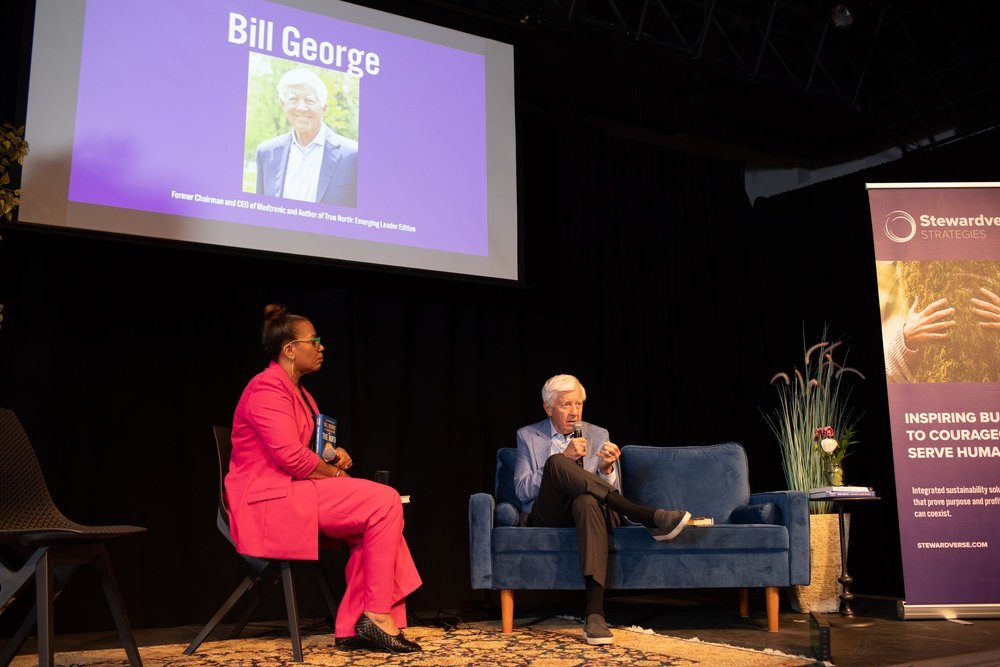
Chanda Smith Baker (L) and Bill George at the Stewardverse Business Forum.
Most ethics training in the corporate world is, functionally, risk management. It exists to protect the company from legal exposure. The Institute curriculum is being designed around a different question entirely: What does it take to lead with courage when no one is watching?
This means the curriculum goes to places that compliance training rarely touches:
Identity and purpose. Before leaders can act with integrity under pressure, they need to know what they stand for. The Institute grounds leaders in a clear sense of personal and organizational purpose — what the Institute calls a "grounded identity" — so that values don't evaporate when the situation gets difficult.
Moral courage as a learnable skill. The Institute’s Charter is explicit that leaders must "accept the responsibility to act when incentives, norms, or structures reward harm or neglect." That kind of courage can be cultivated. The curriculum builds it deliberately, through case-based learning, peer dialogue, and honest self-assessment.
Systems awareness as an ethical imperative. One of the Institute's most distinctive contributions is its insistence that ethical leadership requires understanding interconnected systems — human, environmental, economic, and technological. A Stewardverse leader anticipates how their decisions ripple through supply chains, communities, natural systems, and generations.
Truth-telling and accountability. The Institute positions itself as "a disciplined environment for truth-telling, learning, and accountability." This is not window dressing. The cohort model, peer networks, and research frameworks are all being designed to create the kind of honest, reflective community where leaders can examine their decisions without defensiveness — and grow from what they find.
Mega-Force Readiness: Ethics in the Age of Technological Disruption.
We have identified six mega-forces around which the Institute’s work streams will be structured: Ethics & Integrity, AI & Quantum, Natural Resources, Global & Local Commerce, Workforce Demographics, and Health & Wellness.
Technological disruption cuts across each of them.
Business ethics doesn't exist in a vacuum. It is being stress-tested right now by the rapid, largely unregulated expansion of artificial intelligence and the mind-blowing potential of quantum computing.
The Institute prepares leaders to approach new technologies as an ethical challenge that demands the same underlying leadership character: honesty, systems awareness, and a willingness to hold a longer time horizon than the next quarter.
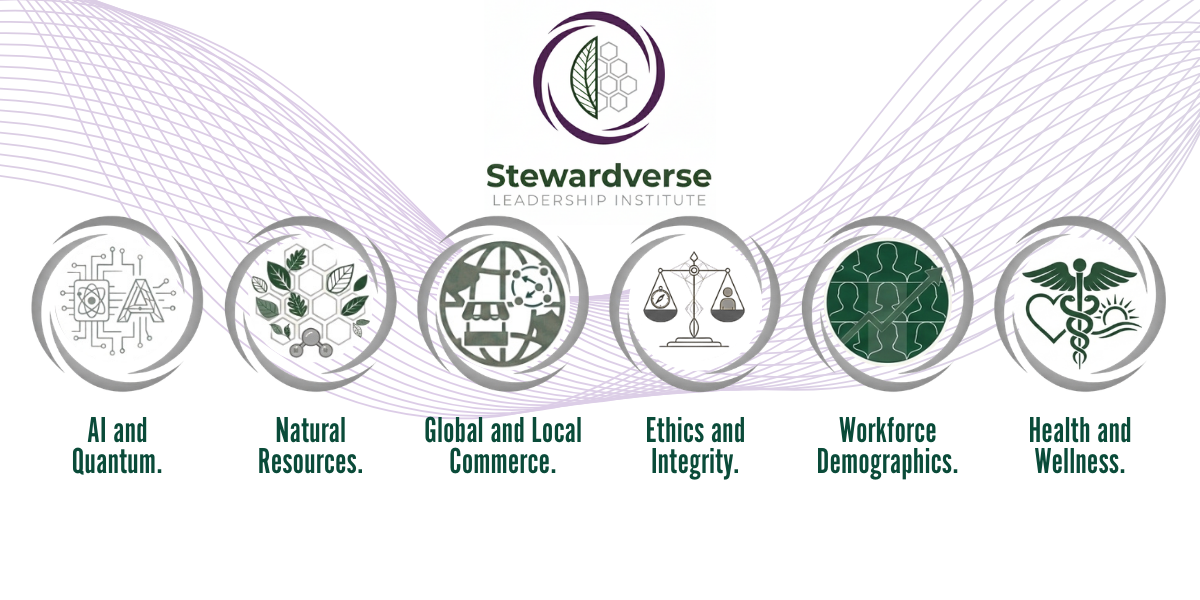
The six forces shaping the Stewardverse Leadership Institute’s agenda.
The Generational Dimension.
Another distinctive feature of the Institute’s approach to ethics is its insistence on a generational frame.
"Leadership decisions are evaluated against their consequences for future generations, not solely current stakeholders," our charter states.
This is not a platitude. It is a concrete reorientation of how leaders assess trade-offs. When the question is not only "what does this do to our Q3 numbers?" but "what does this do to the world my children will inherit?", the ethical calculus changes. The Institute’s curriculum will build that longer lens directly into its decision-making frameworks.
What Gets Carried Forward.
The Stewardverse Leadership Institute is being founded on the conviction that the current dearth of leadership ethics is not inevitable. Our ambition is to help business leaders prioritize character over compliance, and long-term responsibility (to people, to the environment, and to financial stability) over short-term benchmarks.
Transforming ethics and integrity into a strategic core value will drive genuine business value. This evolution shifts the focus toward a decision-making model where the most critical work occurs during the initial planning stages. Ultimately, this approach recognizes that true business success is generational; by aligning commercial rewards with the well-being of people, the environment, and future stakeholders, companies ensure long-term viability and purpose.
Leaders who complete the Institute Ethics & Integrity curriculum don't leave with a certificate and a set of rules. Instead, they gain their own coherent moral framework that holds up under pressure, a community of peers who share a commitment to honest leadership, and a set of practical tools for aligning organizational decision-making with values that extend beyond the next earnings call.
The Stewardverse® Leadership Institute will offer cohort-based learning and a global community for leaders committed to ethics, integrity, and purpose-driven enterprise. Learn more at www.stewardverse.com.
Erik Brand is External Affairs and Stakeholder Relations Lead at Stewardverse Strategies.
© 2026 Stewardverse Strategies. All rights reserved.
