
What seven years taught me about stewardship, personally flourishing, and leadership.
by: Devry Boughner Vorwerk
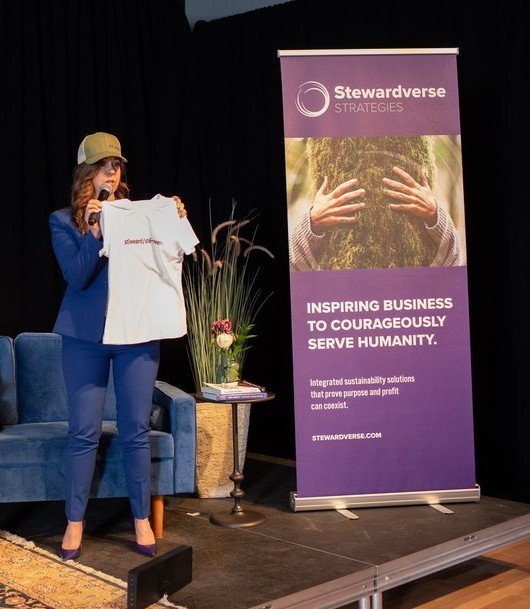
Devry sharing company merch on Earth Day 2026.
Lousy T-shirt?!
Lately I’ve been posting photos wearing a new t-shirt.
If you’ve seen me on LinkedIn, Insta or Facebook recently, you’ve probably noticed it. Across the front are the words STE-WERD, a playful nod to the idea of stewardship and to the launch of Stewardverse Strategies.
The shirt is part of our company’s new merch line. A few people have asked what it means. Others have politely wondered what exactly I’m up to. One woman at the gym approached me and said she was a flight attendant and asked if I was one, too? She reminded me that they are not called stewardesses anymore.
What is a steward? The truth is, I’ve been asking myself a similar question.
This summer marks seven years since I stepped away from a corporate leadership role. Seven years of building a business, launching ideas, closing ideas, succeeding, failing, pivoting, learning, and growing.
And now, apparently, wearing branded t-shirts.
The title of this article comes from a joke many of us grew up with in the 1970s and 1980s. Our parents would return from vacation and all we got was a souvenir shirt. The phrase became shorthand for a journey that seemed bigger than the tangible thing brought back.
As I reflected on the last seven years, I realized that the joke contains a deeper truth.
After seven years of entrepreneurship, leadership, reinvention, and becoming, it might appear that all I got was a t-shirt.
But what I actually gained was a new understanding of stewardship.
The timing feels appropriate. Seven-year cycles show up everywhere. We talk about the “seven-year itch” in relationships. Agriculture has long recognized cyclical patterns that often unfold over seven years (i.e., cattle or hog cycles). Many faith traditions, leadership traditions, and developmental models point to seven-year seasons of growth and renewal.
Whether those cycles are scientific, symbolic, or simply human observations, I find myself recognizing that I am entering a new season.
More importantly, I am noticing that many leaders are entering one too.
Recently, as we gathered leaders for our Stewardvese Business Forum on Earth Day 2026 and continued to shape the vision for the Stewardship Leadership Institute, I felt something come into focus. The many threads of the last seven years were not disconnected. They were revealing a pattern that had been present all along.
The word is stewardship.
Stewardship Challenges.
For many years, people have known my work through different lenses. Some know me through food, agriculture, and my work on hunger and food security. Others through sustainability, international trade, corporate affairs and communications, business strategy, public policy, leadership, faith, health, coaching, community building, running, yoga, or education. I understand that. Those have been the visible expressions of my work.
But underneath them all has been a deeper question: what am I doing with what has been entrusted to me?
Increasingly, I believe many of the challenges we face as leaders are not simply sustainability challenges, business challenges, management or leadership challenges, economic challenges, or social challenges. They are stewardship challenges.
Stewardship is not new to me. I was raised in it. Community and nature were formative figures in my life. I grew up with an understanding that we are responsible to one another and to the places that shape us. Land, neighbors, foreign citizens, food, faith, work, and service were not separate categories. They were part of a shared way of living.
Perhaps that is why I can breathe into this language more easily now. It does not feel like a new construct I am trying to build. It feels like something I have been returning to.
What is new is that I am seeing more leaders arrive here too.
The construct of leadership is changing. Leaders are beginning to recognize that they are more than the roles they hold, the strategies they deliver, or the organizations they represent. They are whole people. Their health, relationships, values, culture, faith, resilience, integrity, and sense of calling all shape the way they lead.
For too long, leadership asked people to fragment themselves. Bring the expertise, but not the whole person. Bring the strategy, but not the story. Bring the performance, but not the formation.
I think that is changing.
The leaders I see creating the most trust are not the ones pretending to be separate from their humanity. They are the ones becoming more integrated. They understand that leadership is not only about what we achieve. It is about what we cultivate, what we repair, what we protect, what we release, and what we leave behind.
The Stewardverse Ecosystem and The Seven Practices of Stewardship.
That is why I have started to think of stewardship as an ecosystem rather than a model or a framework. An ecosystem is alive and requires expression, movement and interconnectivity. The health of one part affects the health of the whole.
For me, that ecosystem includes seven leadership practices stewardship of self, relationships, organizations, creation, resources, calling, and time.
Stewardship of Self. We cannot sustainably lead others while neglecting our own lives. Health, nutrition, movement, rest, attention, spiritual formation, and inner discipline are not separate from leadership. They shape our capacity to be present, grounded, discerning, and courageous.
Stewardship of Relationships. No accomplishment can replace trust, love, family, friendship, mentorship, and community. As a mother, daughter, sister, friend, coach, and community member, I have learned that relationships are not interruptions to meaningful work. They are part of the work.
Stewardship of Organizations. Across agriculture, food systems, sustainability, trade, corporations, governments, and politics, I have seen that organizations eventually reflect the stewardship capacity of their leaders. Culture, trust, resilience, and long-term value do not emerge by accident. They are cultivated.
Stewardship of Creation. Agriculture teaches us that we are not separate from the natural world. We are participants in it. The future of food, climate resilience, biodiversity, and prosperity depends on our willingness to move beyond extraction and toward regeneration. The earth is not merely a resource. It is a gift, an inheritance, and a responsibility.
Stewardship of Resources. As leaders we are asked us to examine what we do with money, capital, knowledge, influence, networks, time, talent, and opportunity. Resources are not neutral. They can be used to create flourishing or depletion. Stewardship asks us to move beyond ownership and toward responsibility.
Stewardship of Calling. Calling is the deepest layer. Each of us has gifts, experiences, responsibilities, and opportunities that are uniquely ours to offer. For me, faith has always been central to understanding my calling. I do not believe our purpose is simply to accomplish more. I believe it is to become more fully who we were created to be.
Stewardship of Time. Time has become one of the most important stewardship practices in my life. Not because there is never enough of it, but because it shapes the way we experience everything else. Stewardship of time is not about squeezing more productivity into the day. It is about learning to be present to the life we have been given. It is taking time to notice the changing seasons, to walk in the woods, to sit beside a lake, rescue a snapping turtle from the road (I literally did that this morning), to watch a sunrise, or to listen to birdsong without rushing to the next thing. Nature reminds us that life unfolds in rhythms, cycles, and seasons. Nothing blooms continuously. Nothing grows without rest. Stewarding time means honoring those rhythms in ourselves and in others. It means recognizing that every moment is both a gift and a responsibility. The present moment is where life happens, yet every decision we make carries forward into the future. When we stop stewarding time, we lose our sense of presence, our connection to creation, and often our awareness of what matters most. Stewardship calls us back to all three.
This is the clarity that seven years has given me: The Seven Practices of Stewardship.
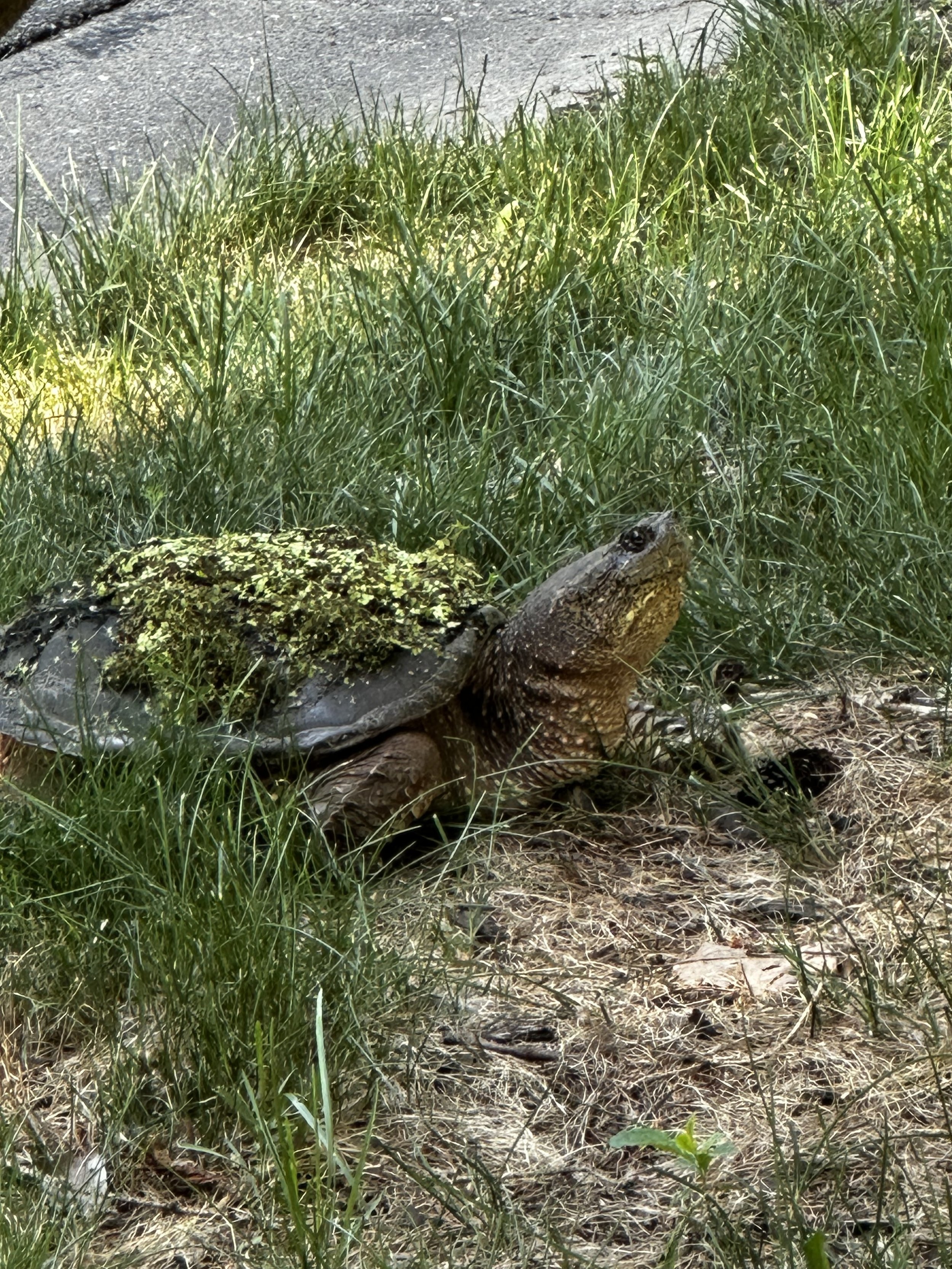
A snapping turtle that Devry stopped to steward across the street. We do that in Minnesota. We take time for turtles to cross the road.
Becoming A Steward.
The next season of my leadership, and the next season of our company, will continue to grow from this conviction. Stewardship is resonating because people already know the old constructs are not enough. They are looking for language that honors responsibility, relationship, wisdom, and long-term flourishing.
I am not alone in seeing this. I am simply naming what many leaders are beginning to feel:
We need a more integrated way to lead.
We need leaders who can bring their whole stewardship selves into the rooms where decisions are made.
We need leaders who understand that business, community, creation, health, resources, and calling are connected.
Seven years ago, I stepped away from a corporate role without knowing exactly where the path would lead. And yes, after seven years of leadership, entrepreneurship, reinvention, and becoming, I did get a t-shirt.
But I also gained a deeper appreciation for what it means to steward a life, a family, a business, a community, and a calling. The shirt is simply a reminder that leadership expectations are changing. A reminder that we do not have to leave parts of ourselves at the door when we step into leadership.
A reminder that business, personal health, relationships, faith, community, and creation are not separate conversations. They are connected.
Most of all, it is a reminder that we do not become who we are meant to be all at once. We become through the practice of stewarding one season, one relationship, one decision, and one act of faithful responsibility at a time.
And if all that becoming over the past seven years comes with a lousy—yet sustainable—t-shirt, well, that's not such a bad souvenir after all.