
Long-Termism for Business in the Reconfiguration Economy.
Competing Visions for the Future of Capitalism and Humanity.By Devry Boughner Vorwerk
Last week I was in New Haven, Connecticut, home of Yale University, speaking to a group of Page Society Future Leaders who are exceptionally talented executives advising the leadership and C-suites of some of the most influential companies in the world. The conference was focused on Creating Long-Term Stakeholder Value and the topic I was asked to cover was Sustainability and Global Business Dynamics, our sweet spot at Stewardverse Strategies.
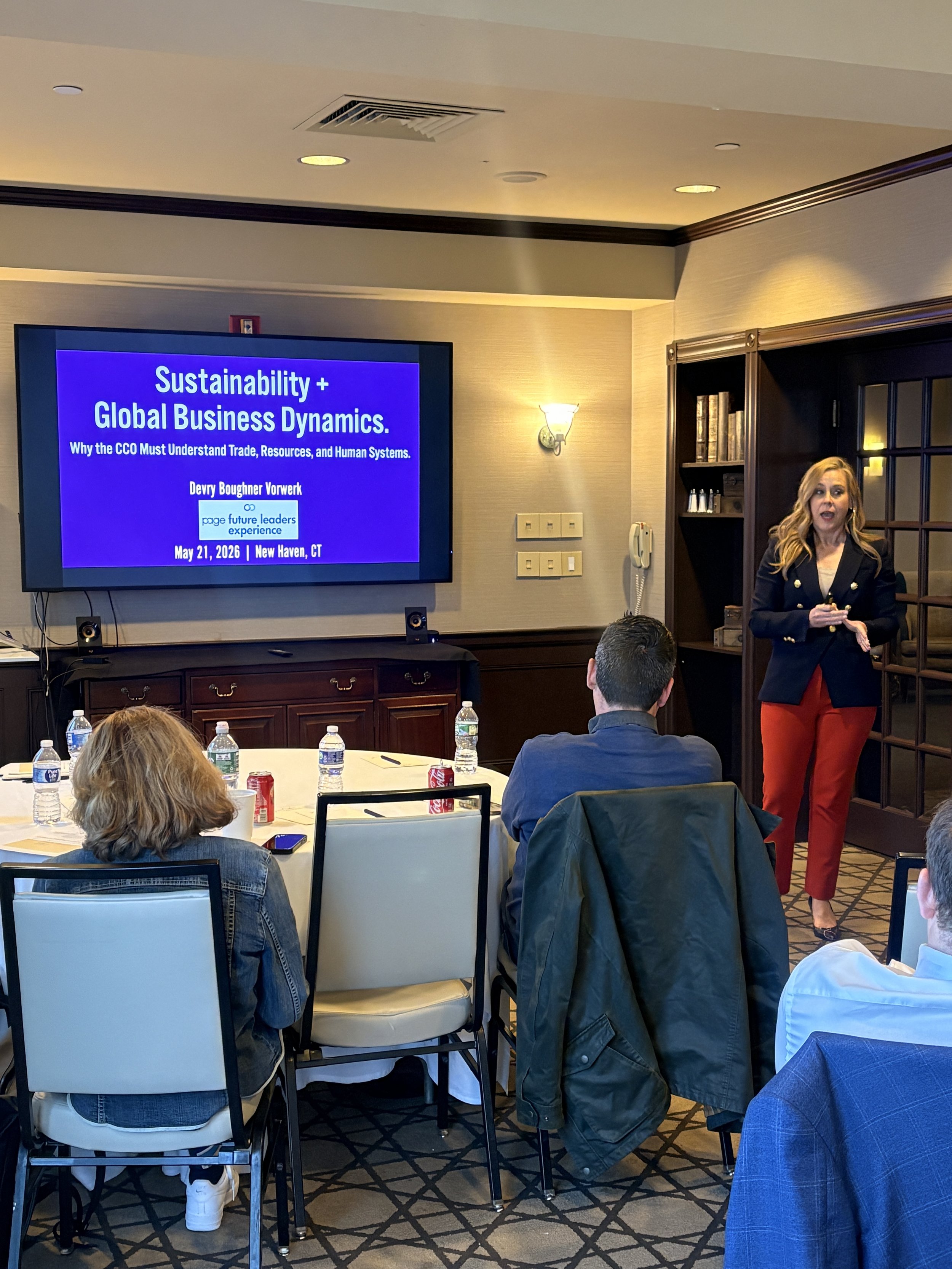
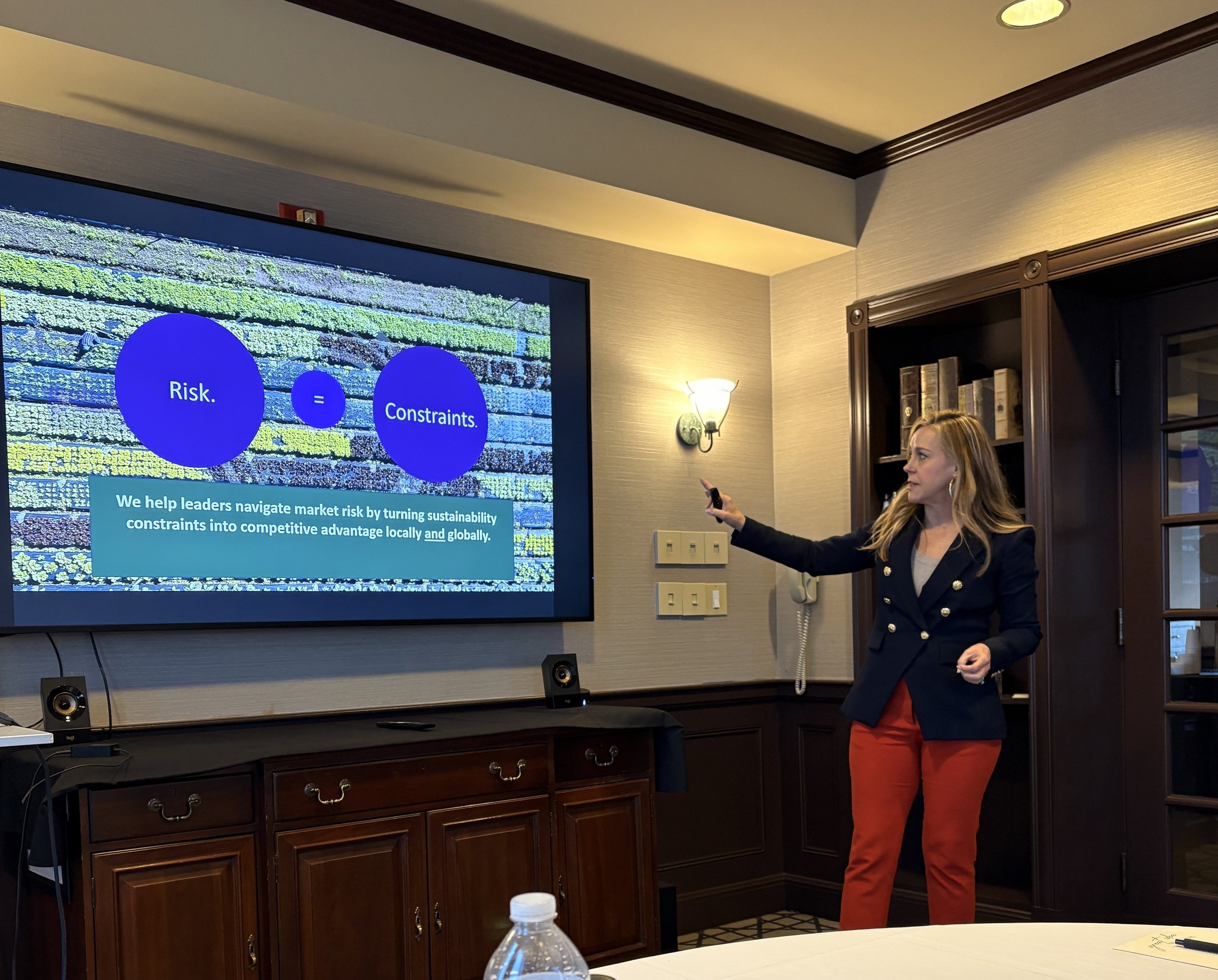

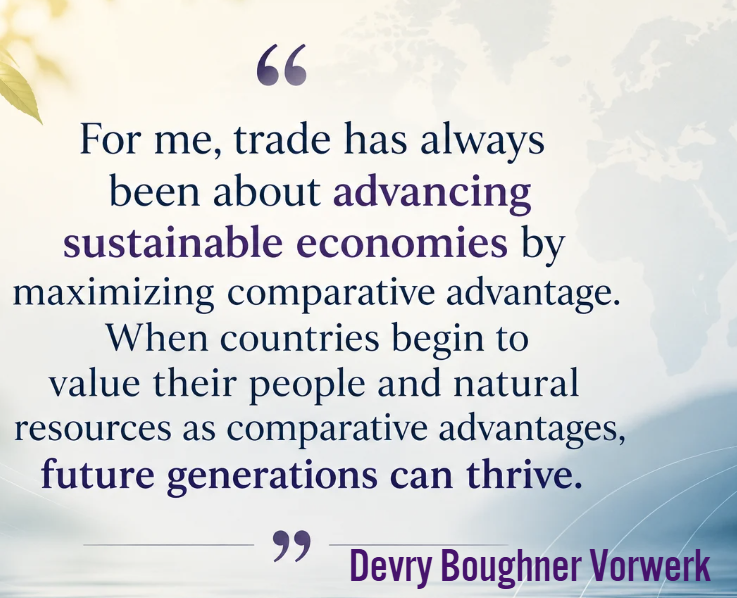
I arrived at the conference with a message I wanted to pressure test: globalization is not dead, it’s simply reconfiguring. I named it the “Reconfiguration Economy,” an economy that significantly benefits those companies that have amassed enough capital to carry out their own vision of the future. I explained that the Reconfiguration Economy is coming on the heals of what I call the “Convergence Economy” that made its way over the last 30 years as a result of the successful conclusion of the Uruguay Round global trade negotiations in the World Trade Organization and the Paris Accord on Climate. Really, the past 30 years have been about setting and converging guidelines, trade rules, and more transparent boundaries for business to trade and invest in more sustainable ways.
Now, the global economy is reconfiguring around consolidation of capital and concentration of industry players. Capital accumulation comes also with political connections and know-how on navigating the global marketplace amidst the regulatory, policy, and geopolitical disruption. Those companies that succeed are aptly arbitraging the trade barriers that are being lobbed in real time into the marketplace in ways that benefit them, and the economic gains from lack of transparency and disregard for the rules-based trading system are astounding.
Capital begets capital. The more capital accumulated in the “trade-lawless” economy, the more opportunity to accumulate more capital. Some companies can thrive in this reconfigured economy, and sadly, many companies suffer and are simply making it from quarter to quarter.
From convergence to reconfiguration has been swirling in my mind and led to an epiphany as of late that the narrative on why sustainability is not progressing is stale. The accepted narrative is that companies are not investing enough in sustainable outcomes for their business because they only focus on delivering against the short-term P&L, not the long term health of people and natural systems.
I am now beginning to understand that short-term financial pressures to deliver for shareholders is only one part of the story. I submit that most companies are focused on their long-term, generational success, but often from the narrow scope of whether the company can survive, not whether the very resources it uses to make the company go—people and nature—are better off. While executives may want to think that way, unless they are intentional that the business must be of service to people and nature in both the present and future state, sustainability gets sidelined.
Don’t get me wrong. There are many companies that are focused on the health of people and nature, but the access to affordable capital to invest in sustainable outcomes is constrained. I continue to become frustrated with what I view as a massive misallocation of capital toward shiny objects that have nothing to do with addressing the current and future condition of humanity like solving for poverty, food insecurity, and chronic hunger.
Many companies with massive capital accumulation have enough financial wherewithal to break things in the short term, take financial losses, all with the mindset that they are making the future in their own company’s image, not in the image of what humans need to flourish.
My point is: all businesses are thinking about the long term, but are they thinking about it in terms that support the longevity of humanity? Some of the most powerful and well capitalized companies in the world are thinking further ahead than governments, civil society, and most communities can even process right now.
Thinking ahead and planning for the future of the business is not the problem. The problem is that we are beginning to mistake all long-term thinking as inherently good. It is not.
There are competing visions of the long term now emerging in the global economy, and I do not believe we are speaking honestly enough about that reality. Some companies are building toward a future rooted in stewardship — of people, natural systems, communities, and future generations. Others are building toward resilience for themselves.
Those are not the same thing.
And in this new “reconfiguration economy” now taking shape, the difference matters enormously. Because what we are watching unfold is not the end of globalization. It is the end of a particular form of globalization — one built, however imperfectly, around expanding rules-based systems, transparency, multilateral trade frameworks, and broader participation in economic growth.
That system had flaws. Many flaws. Why? Because the humans administering the systems are flawed. But the post WWII system also created pathways for countries, businesses, entrepreneurs, and citizens to compete, innovate, and rise, and with a deep focus on accountability to laws and morally acceptable behaviors.
Now we are entering something different, which is a world increasingly shaped by:
capital accumulation, AI acceleration, resource insecurity, country-specific industrial policy, geopolitical fragmentation, and technological concentration.
The long-termists are already here. My question is: long term for whom?
That question sat at the center of a slide I presented in New Haven called “Long-Termism in Business.” The slide itself is intentionally messy because I need more time to think it through and because the systems themselves are messy. Capital, technology, trade, incentives, labor, nature, governance, and politics are now colliding all at once.
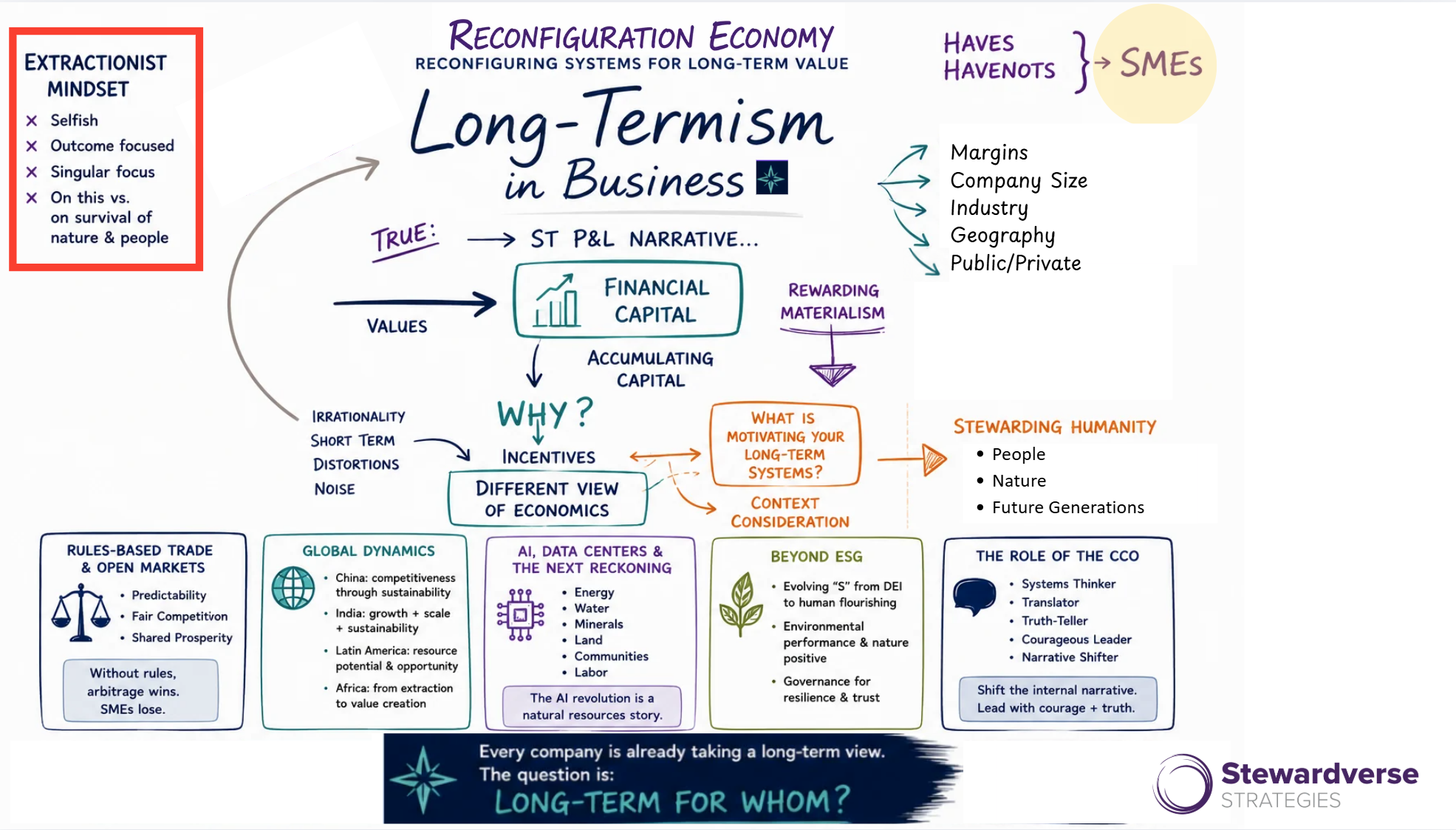
Image description: Devry’s depiction of two competing long-term visions for business.
At the center of the slide sits financial capital.
Because whether we want to admit it or not, accumulated capital increasingly determines who gets to shape the future, who can withstand instability, who can absorb tariffs, who can build AI infrastructure, who can acquire energy access, who can secure water, who can move markets, and who can survive disruption long enough to benefit from it. And who cannot. Capital accumulation has always been the issue, yet coupled with capital concentration, the world of business has an entirely new headache to manage.
That is the part of the sustainability conversation many people still avoid. The divide forming now is not simply between wealthy people and struggling people. It is also between wealthy companies and everyone else.
As I mentioned earlier, large global firms can arbitrage instability in ways small and midsized businesses simply cannot. They can reroute supply chains, absorb compliance burdens and push them down the chain, deploy technology rapidly, influence standards, and withstand political volatility.
Meanwhile, many smaller businesses are trying to survive quarter to quarter inside a deeply unstable operating environment. So, when large corporations or institutions speak about “long-term sustainability investments,” many SMEs hear something entirely different:
survival deferred. Not because these business leaders are immoral and do not care. It’s more so because their balance sheets force a different time horizon. And this is where I think the conversation around sustainability has become far too shallow. The issue is not whether companies are “pro-ESG” or “anti-ESG.”
The issue is incentive structures. What is motivating the leadership? What future is the organization optimizing toward? Because not all long-termism is stewardship. Some of it is extraction with a longer runway. Sadly, that may be the defining realization of this Reconfiguration Era. Nowhere is this becoming more apparent than with artificial intelligence.
AI is being discussed largely as a technological revolution, but that framing misses what is actually happening underneath. AI is a natural resources story. It is an energy story. A water story. A land story. A minerals story. An infrastructure story. A labor story. A governance story. And right now it is moving faster than society’s ability to collectively govern it.
Christopher Olah of Anthropic recently remarked in his comments in front of Pope Leo XIV that AI “must go well for humanity.” I appreciate the honesty in that statement because it acknowledges something important: there is no guarantee that it will. At the same time that Pope Leo is asking for disarmament of AI, Anthropic is also wanting to sell its tool to the Department of War.
Unless governments, businesses, the faith community, and civil society organize around a shared stewardship business framework, AI risks accelerating the divide between the haves and the have-nots at extraordinary speed, and not just among people, but among industries, businesses, nations, and communities.
We cannot leave the management of systems this powerful solely in the hands of technologists or capital markets, which is why I increasingly come back to the steward.
The steward understands something the extractionist often does not: people and nature are not simply inputs. They are a belief system, a belief that our planet was bestowed with resources to enhance our human existence, not extinguish it.
Every business transforms something taken from people and nature into “value.” The question is whether we replenish what we take. Do we restore, strengthen, and leave systems more resilient than we found them? Or will we simply optimize extraction until instability becomes unavoidable?
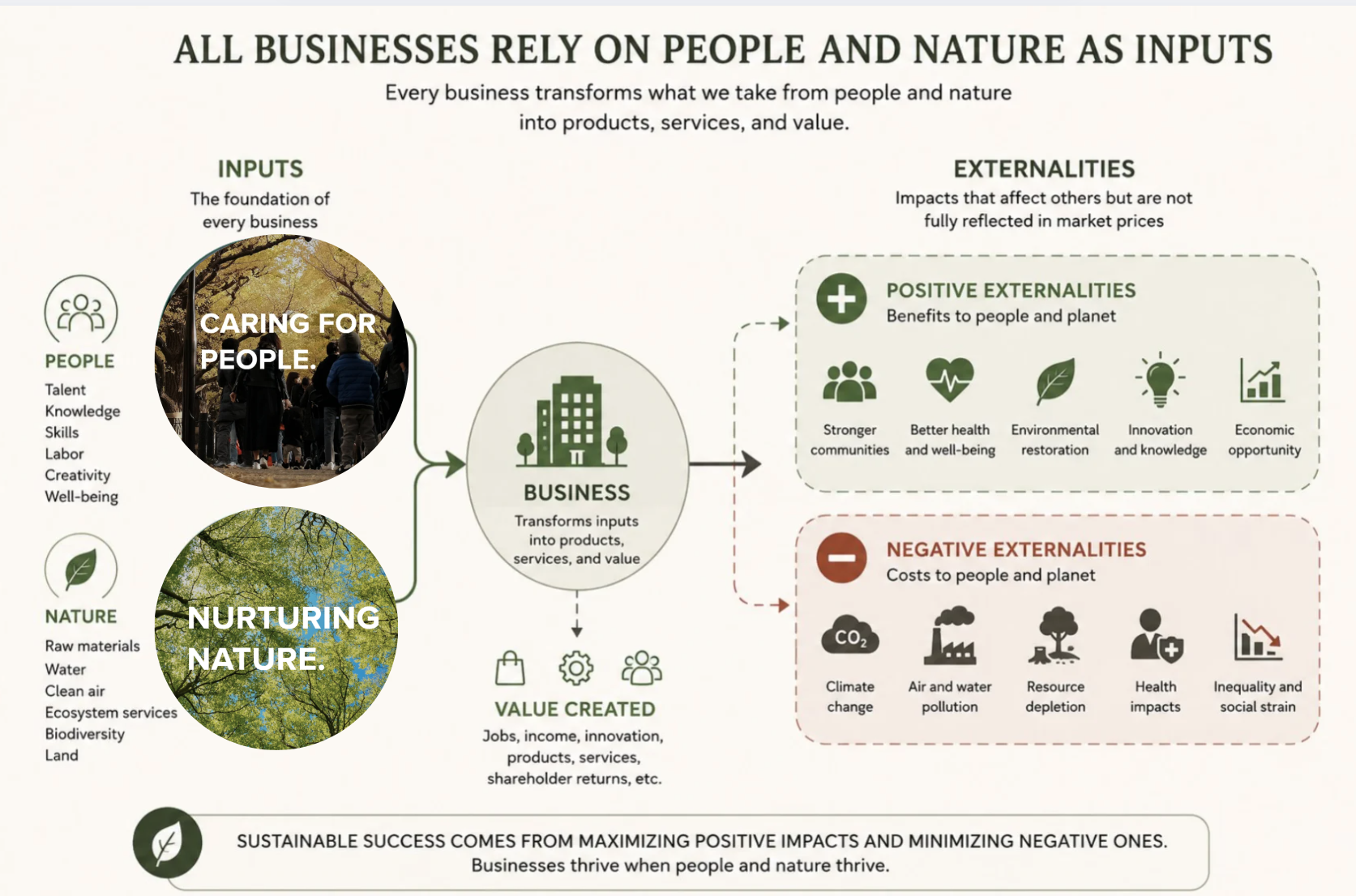
Image description: Stewardverse Strategies’ depiction of people and nature as business inputs and the externalities business creates for society..
My unyielding faith in God is why I continue to believe sustainability still matters deeply, even amid the backlash. Sustainability not as branding. Not as politics. Not as performance theater (i.e., greenwashing). Sustainability as the operating framework through which societies negotiate how business, trade, technology, and humanity coexist.
I believe this is ultimately the road now diverging before us. One path continues toward concentrated power, accelerated extraction, fragmented systems, and resilience for the few. The other asks whether business still possesses the courage to steward something larger than itself.
I still believe many leaders want to take that second road. We see those leaders every day in our clients, in the teams that continue to strive in the face of great financial, environmental, and social constraints to the business. Those are the leaders we must look to carry humanity forward. It is The Stewardverse® Leader that is equipped to courageously serve people, nature, and future generations.
In closing, business leaders now face a choice far greater than whether to support sustainability initiatives or invest in the latest technology platform. The real choice is whether they are willing to help build systems capable of sustaining humanity itself.
That may sound dramatic, but I no longer believe it is an overstatement.
We are living through a period where capital, AI, natural resources, geopolitical instability, and technological acceleration are reorganizing power faster than most governing systems can respond. The temptation during moments like this is to retreat inward — to protect margins, consolidate control, optimize for survival, and call it long-term thinking.
But resilience for the few is not stewardship, and eventually systems built only for concentrated advantage destabilize themselves.
This is why I believe business leaders, especially those leading small-cap and mid-cap companies, cannot become complacent or disengaged. SMEs remain one of the greatest forces for innovation, local economic resilience, employment, and community stability in the world. But they must organize, collaborate, and advocate for transparent and rules-based systems that allow them to compete fairly in this reconfigured economy.
Our future should not be determined by who accumulates the most capital, but by who chooses to steward humanity with it, ensuring that future generations inherit systems capable of sustaining not just the few, but the masses.
I welcome your comments and additions to my thinking on long-termism and the Reconfigured Economy. It’s always helpful to iterate thinking on the best pathway forward for business and humanity. Send me a note on LinkedIn or to inquiry@stewardverse.com.